
FRANCE ON HORSEBACK |
Horse riding tours and equestrian holidays in France |
|

Since 1998, Ride in France is dedicated to horse riding tours and equestrian holidays in France.
Ride in France is part of Randocheval, the leading French equestrian agency, which offers rides in more than 50 countries. We even have our own travel agency in Mongolia!
No need to say that our team of French horse lovers has the best knowledge about horseback holidays in our own homeland!
Be ready for the equestrian adventure of a lifetime in France!
 |
 |
 |

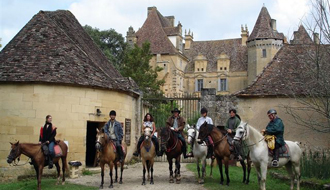
Whether you are dreaming of fairy castles or enjoying French cuisine and wines, we have a ride for you! Discover our "special interest rides" to find your dream equestrian vacation in France ...
Read carefully all the information about our tours. Once you have chosen your ride, contact us to check the availability.
We will send you a booking form, you just have to fill it and send it back.
Payment is done very easily through wire transfer or credit card. You will receive the voucher and all necessary information as soon as the booking and payment has been completed.

It is important that you prepare your riding holidays to make the most of your equestrian adventure!
The following pages should answer all your questions about France, French horses and how to prepare your horseback vacation. Feel free to contact us if you need more detailed information.
French riders trying and trusting horse riding tours in France, it says it all !
We offer a top selection of the best rides in France. We offer a unique choice of ...
6 days a week, our 8 riding holidays experts are here to help you. They have tested ...
When you book through Ride in France, you are sure to get the best value for money ...
Unlimited Financial Guarantee of your payments, and protection of ...
Ride in France has been created in 1998 by Sabine et Thomas Grataloup, two horse lovers.
Today 8 experts help you to choose the best ride for you in France : Anne, Claire, Dominique, Julie, Laurie, Mathilde, Sabine and Thomas!

When to Go? - Events - Geography - Climate
|
There is much more than one France! From the Alps highest peaks to the wonderful Provence landscapes, from the oldest villages to the most famous wine regions, what do you want to discover? |
Here, we have gathered the craftiness and practical advice from our rider's experience, in order to help you prepare your riding tour as perfect as possible.
Do not hesitate to share your own tricks with us, so that they profit to all the riders!
You can ridethroughout the year, but you have to know that every seasons is very different.
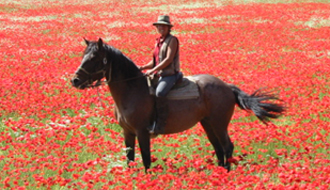
In spring, temperatures are quite warm, especially in May-June, days are long and the flowers all around the country offer astonishing landscapes.
In summer, of course, the temperature can be quite high, but it is always OK for horse riding. This is the best period to explore the mountains, blessed with lower temperatures. During this period, many French people have their annual holidays, so it can be difficult to find availability in hotels, reservations for this period should be made as early as possible.
Temperatures aren't too bad in autumn, although short days mean limited sunlight and cold temperatures start to make themselves felt towards the end of the season, even alongside the Côte d'Azur. But, it is also the season of colorful forests, and for new cooking experiences with wild mushrooms and game (deers...).
Winter is a time for unusual experiences, such as riding in the snow, or discovering the French coasts without the summer crowd!
French people are a festive bunch with many cities hosting music, dance, theatre, cinema or art events every year. Rural villages hold fairs and parties celebrating everything from local saints to agricultural progress.
Prominent national bank holidays are May Day (1st May), when people trade gifts of muguet (lily of the valley in French) for good luck; and Bastille Day (14th July), which is celebrated by throwing firecrackers at friends.
Regional events include the prêt-à-porter fashion show in Paris (early February); the
glittering Cannes Film Festival (mid-May);
the mainstream and fringe theatre Festival of Avignon
(mid-July to mid-August) and many Jazz and Music Festivals.
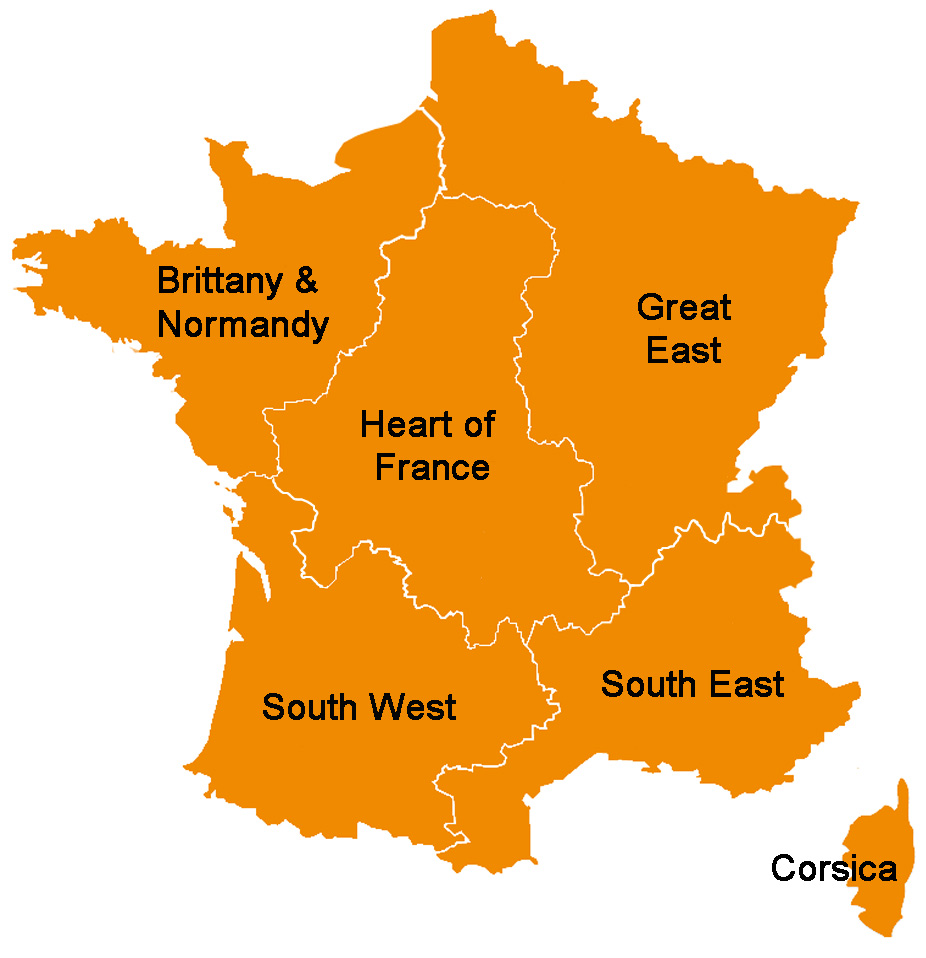
Slightly larger than California, France is one of the largest countries in Europe. The English Channel lies from the north-west and the Atlantic Ocean to the west. Spain broils across the Pyrenees to the south, the Mediterranean (including Corsica) is to the south-east and over the eastern Alps and Jura chains lies Switzerland and Italy. France's relatively flat north and eastern borders abut Germany, Luxembourg and Belgium.
Since 1790, France has been divided into administrative units of about 6100 sq km (2380 sq mi) called "départements". There are 96 "départements" in France and a further five overseas.
The French Alps include Mont Blanc, which is 4800m high (15,750ft) and is Europe's highest peak. In winter, they offer one of the best places for skiing in the world. The Pyrenees, between France and Spain, are well-preserved and remain a paradise for riders... The most spectacular of France's ancient chains is the Massif Central, a huge region in the middle of France that covers one-sixth of the country.
The country's longest river, the Loire, runs on 1020km (630mi) from the Massif Central to the Atlantic Ocean. The Seine, Rhône, Garonne and Rhine are France's other major waterways, draining the plains and funneling huge runoffs from the mountains.
Over 3200km (1985mi) of coastline ranges from the chalk cliffs of Normandy and the promontories of Brittany to the fine-sand beaches along the Atlantic.
The south-eastern Mediterranean coast tends to have pebbly, sometimes rocky beaches. However,the Languedoc and some of the Roussillon beaches have sand-castles potential!
France's mix of climates and grounds have endowed the country with a rich variety of flora and fauna. Unfortunately, many fragile species, such as the Pyrenees ibex, Corsican deer, brown bear, wolf and otter now face extinction. Several animals and birds - the chamois (a mountain antelope), the larger "bouquetin" (a type of ibex), beaver, stork and vulture - still live in the wild thanks to re-introduction programs based in national parks. Forests - of mostly beech, oak and pine trees- cover roughly one-fifth of the country. These wooded areas, as well as vast wetlands, support the bulk of the country's mammals and birds.
France has a predominantly temperate climate, with mild winters, except in mountain areas and in the north-east. The Atlantic has a strong impact on the north-west, where the weather is characterized by high humidity, often violent westerly winds and a lot of rain. France's north-east has a classic continental climate, with fairly hot summers and cold winters. In the centre of France, the Paris basin boasts the nation's lowest annual precipitation, but rainfall patterns are erratic. Paris' average annual temperature is 12°C (52°F), but the mercury sometimes drops below zero in January and can climb to the mid-30s°C (95°F) or higher in August.
The southern coastal plains are subjected to a pleasant Mediterranean climate: frost is rare, spring and autumn downpours are sudden but brief and summer is virtually without rain. The south is also the region of the 'mistral', a cold, dry wind that blows down the Rhône Valley for about 100 days a year.
CAPITAL CITY
Paris with 13 million of inhabitants
LANGUAGE:
French (but also Alsatian, Breton, Basque, Catalan,
Provencal & Corsican)
MONEY
The Euro. Some of your purchases can be paid with your international credit card. You can also withdraw some cash from most of the cash dispensers.
Note that each time your withdraw some money, your bank will debit you banking fees according to where you come from. You should withdraw an important amount of money at once rather than a small amount several times.
FORMALITIES
Citizens from the EU, the USA, Canada, New Zealand, Australia and Israel do not require visas to visit France as tourists for up to three months. Except for people from a handful of other European countries, everyone else must have a visa.
Anyway, check with your local Embassy according to your nationality.
HEALTH RISKS
Your main risks are most likely sunburns,
foot blisters, and upset stomachs from overeating and drinking!
TIME
GMT/UTC plus one hour
Power
220V, 50Hz. Buy a power adapterif necessary, for American and English people for example.

 +33 437 02 2000